Showing posts with label modelling books. Show all posts

Monday, 4 December 2017

Term 4 2107 - Inquiry Update

In Term 4, I wanted to explore how I could use modelling books more effectively to scaffold my priority students to improve their problem solving strategies. 

I had initially thought that taking photos of the working out recorded in the modelling book would be sufficient but have realised this is not necessarily a great leap forward as I have really just created a digital version of the original modelling book. 

After talking with my inquiry group leader, he explained that if I am to take the modelling book to the next level I need to make it a resource that will allow students to 'rewind their learning' so that at a time and place that was convenient for them they can access previous work.

This made total sense and it would be possible to achieve this by simply adding an audio track (from myself or ideally the students themselves) that would allow anyone using the online modelling book to have instructions to guide them on how to use a given maths strategy.

This innovation is something that will be useful across all subject areas so that any prior learning can be shared for others to access.

What a year 2017 has been! It has taken a while to wrap my head around the Teaching as Inquiry process and navigate the process of how to reflect on my teaching practice when as a Beginning Teacher there feels like there is still a lot more learning to be done.  

To get real benefit from this reflective practise, I want to have a clear focus (subject area, target students) and then quickly gather relevant historical data as a starting point. I then need to be more methodical in how I select, implement, monitor and analyse how a change in an aspect of my teaching practise will positively impact my target learners. Bring on 2018!

Wednesday, 18 October 2017

Term 3 Inquiry Update: Rich Learning Activities

In Term 3, my priority students changed and I revamped my inquiry focus question to investigate the extent to which the format of maths problems will influence the problem solving abilities of my target students.

My latest hunch was that the format of the questions I gave to the students was impacting on their ability to be successful in problem solving.

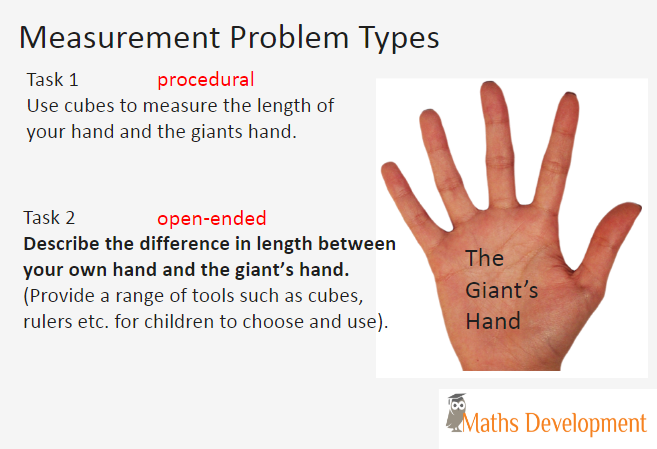
A PD session with Jo Knox highlighted the benefits of using open ended, rich learning tasks (like the 'Giant's Hand' activity to the right) as a way to engage and challenge students. She explained a resource bank is available on the nzmaths site. 
I chose rich learning activities that matched the term topic of Geometry & Measurement. To explore the concept of perimeter further, I chose the Parking Cars task for my priority group. Students needed to work out a new car park layout for a specific number of vehicles.

First we unpacked the problem in our group session and clarified key details e.g the dimensions of the parking lot and the required car spaces. I was explicit in telling them that there may be more than one possible result. Despite some initial hesitation to this 'new' kind of problem after the discussion, the students were all super keen to head off and be the first to work out a possible solution. Working with a buddy or on their own, some made a screencastify recording to explain their 'solution'.
Samples of student work are below:

Click here for Junior's full blog post


Click here for Kerstein's full blog post


The open ended and real-life nature of the rich tasks totally engaged the students and without any prompting from me. They willingly took longer to work through different options and were less focused on finding the 'right' answer. Their end solutions highlighted how students had interpreted (or misinterpreted) a problem and so provided me with a useful starting point for a discussion to find out more about their thinking process.

I was really pleased with the students' positive response to the 'rich' task and would like to use them with all the groups. The challenge will be to find tasks that are appropriate - not too hard or not too easy - and linked to the given maths topic being reviewed.

As Term 4 kicks off, the next hunch I would like to explore is how modelling books can be used to effectively scaffold my priority students in problem solving strategies.