Monday, 22 January 2018

Inequality in Education: Dr Pedro Noguera

Dr. Pedro Noguera was the keynote speaker at a workshop run by the Pacific Research Symposium on January 28th. His presentation highlighted the barriers to education faced by males of colour (African-American and Latino) in the US and provided parallels to a similar plight being experienced by young Maori and Pasifika men in Aotearoa/NZ.

He urged us to acknowledge that the current solutions/education institutions are 'not working' for them and argued that the system, that encourages inequity in education, needs to change. He offered up examples in NZ (Kia Aroha School) and the US (Eagle Academy) of new learning models where a student's culture/heritage is an asset and provides the platform for building success at school and sets them up to access improve life circumstances/opportunities.

I found his talk very thought provoking - what kind of role models do our children have to look up to - professionals? sports stars? entertainers? what expectations do we as teachers have for our students?how can we as teachers keep our kids engaged and motivated in their learning?

Monday, 4 December 2017

Term 4 2107 - Inquiry Update

In Term 4, I wanted to explore how I could use modelling books more effectively to scaffold my priority students to improve their problem solving strategies. 

I had initially thought that taking photos of the working out recorded in the modelling book would be sufficient but have realised this is not necessarily a great leap forward as I have really just created a digital version of the original modelling book. 

After talking with my inquiry group leader, he explained that if I am to take the modelling book to the next level I need to make it a resource that will allow students to 'rewind their learning' so that at a time and place that was convenient for them they can access previous work.

This made total sense and it would be possible to achieve this by simply adding an audio track (from myself or ideally the students themselves) that would allow anyone using the online modelling book to have instructions to guide them on how to use a given maths strategy.

This innovation is something that will be useful across all subject areas so that any prior learning can be shared for others to access.

What a year 2017 has been! It has taken a while to wrap my head around the Teaching as Inquiry process and navigate the process of how to reflect on my teaching practice when as a Beginning Teacher there feels like there is still a lot more learning to be done.  

To get real benefit from this reflective practise, I want to have a clear focus (subject area, target students) and then quickly gather relevant historical data as a starting point. I then need to be more methodical in how I select, implement, monitor and analyse how a change in an aspect of my teaching practise will positively impact my target learners. Bring on 2018!

Thursday, 19 October 2017

Fractions and Decimals with Jo Knox


20171019_103654.jpg


Today Team 5 had the opportunity to watch Jo Knox in action with two different Maths groups (one at Stage 6 and one at Stage 7). The aim was to see her teach students to convert fractions into decimals.

DIAGNOSTIC TESTING Jo asked a series of quick questions to gauge the groups understanding of fractions and decimals based on examples from the Numeracy  Development Project (NPD) resources or ‘Pink books’.


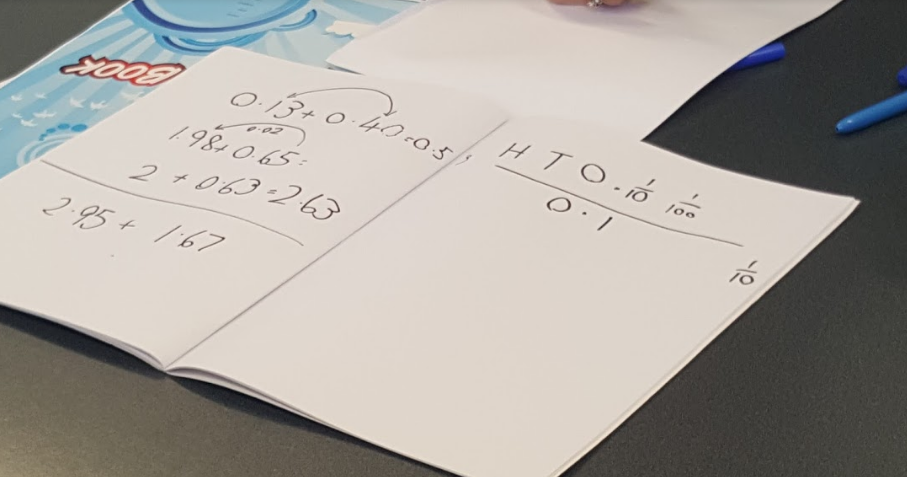
MATERIALS - Decipipes are a really effective tool to help support students to understand the basics of fractions and decimals. They are also easy for students to manipulate, able to break/build up both representations of both fraction and decimal numbers. 

STRATEGY MODEL Start students off using materials then progressing to Imaging and then Materials as students show greater fluency in their use of a given strategy - see NPD Book 3 p5 
e

MODELLING BOOK
 - Number equations were recorded 
in a modelling book in plain view of all students. A handy reference point for the teacher to guide students in their thinking and to record in themselves (see next note).
STUDENT THINKING - Jo regularly asked students to explain their answers. The focus was on how they got an answer, helped to highlight can be more than one ‘correct’ solution; extended this to give specific roles to members of the group - split group into three - one group explained their answer, while a second group modelled the answer using materials (decipipes) and a third group recorded answer in modelling book - this approach ensure all students were fully engaged!

PLENARY - at the end of each group’s session, Jo asked the students to reflect on what they had learned and together they co-constructed the WALT for the lesson in kid’s language - she feels that sharing the WALT at start of lesson isl ike giving away the punchline of a joke upfront


Example 1: WALT Convert fractions and decimals by turning them into tenths, hundredths and thousandths

Example 2: WALT by add numbers by taking one off one number and adding to another to make a whole number


So many golden nuggets from this session! I would like to try out co-constructing WALTs with my students - it will be interesting to see if what I had planned to teach matches up with what students feel they have learnt.

Wednesday, 18 October 2017

Term 3 Inquiry Update: Rich Learning Activities

In Term 3, my priority students changed and I revamped my inquiry focus question to investigate the extent to which the format of maths problems will influence the problem solving abilities of my target students.

My latest hunch was that the format of the questions I gave to the students was impacting on their ability to be successful in problem solving.

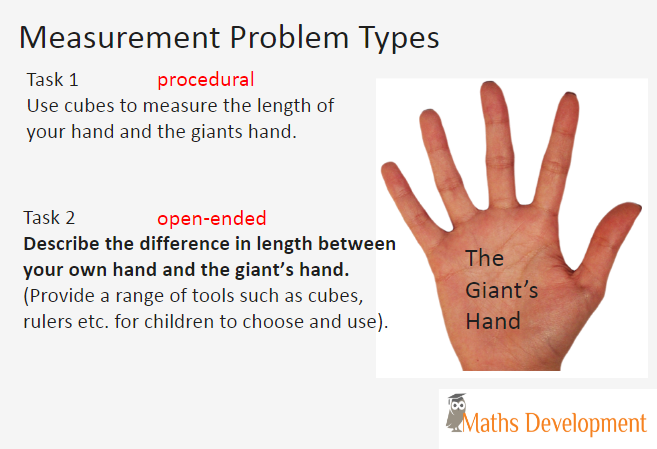
A PD session with Jo Knox highlighted the benefits of using open ended, rich learning tasks (like the 'Giant's Hand' activity to the right) as a way to engage and challenge students. She explained a resource bank is available on the nzmaths site. 
I chose rich learning activities that matched the term topic of Geometry & Measurement. To explore the concept of perimeter further, I chose the Parking Cars task for my priority group. Students needed to work out a new car park layout for a specific number of vehicles.

First we unpacked the problem in our group session and clarified key details e.g the dimensions of the parking lot and the required car spaces. I was explicit in telling them that there may be more than one possible result. Despite some initial hesitation to this 'new' kind of problem after the discussion, the students were all super keen to head off and be the first to work out a possible solution. Working with a buddy or on their own, some made a screencastify recording to explain their 'solution'.
Samples of student work are below:

Click here for Junior's full blog post


Click here for Kerstein's full blog post


The open ended and real-life nature of the rich tasks totally engaged the students and without any prompting from me. They willingly took longer to work through different options and were less focused on finding the 'right' answer. Their end solutions highlighted how students had interpreted (or misinterpreted) a problem and so provided me with a useful starting point for a discussion to find out more about their thinking process.

I was really pleased with the students' positive response to the 'rich' task and would like to use them with all the groups. The challenge will be to find tasks that are appropriate - not too hard or not too easy - and linked to the given maths topic being reviewed.

As Term 4 kicks off, the next hunch I would like to explore is how modelling books can be used to effectively scaffold my priority students in problem solving strategies.

Monday, 16 October 2017

Google Exam - Success at last!


Google Exam Post Script: After a disappointing first effort, I was keen to take another shot at the Level 1 Google Exam.

I lined up a test date with others from the course on the second week of the holidays but unfortunately, a slight hiccup with the retake process from Google foiled my plans! Not to be defeated, I finally took the test again on the last weekend of the holidays - no pressure!

Well, I am pleased to say the wait was worth it - I passed! This success has really made me appreciate just how much I learnt on the DFI course last term - again a huge thank you to Dorothy, Gerhard and Matt! Hmmm, is it time to think about Level 2? Watch this space...

Friday, 22 September 2017

Final Digital Fluency Intensive - Week 9 - Opportunities Galore!

Today marks the end of our 9 week Digital Fluency Intensive (DFI). Alongside a great bunch of educators, I've enjoyed meeting up once a week to learn more about the Manaiakalani pedagogy and have the time to upskill myself in different GOOGLE apps. It has made my life easier both inside and outside of the classroom. A huge thank you to Dorothy, Gerhard, Matt and all the guest speakers!


Thankfully for all of us, the learning doesn't stop here because there lots of other opportunities available to teachers in Manaiakalani to help keep our practise sharp including TOOLKITs,  the Manaiakalani GOOGLE + Community, the EdTech Summit  and being part of Class On Air.


To end up this last session, 11 of us sat the GOOGLE Certified Educator Level 1 exam. 3 hours, 20 multi-choice questions and 11 scenarios later, we needed 80% to pass. Unfortunately a few of us didn't quite make the cut (I got 78%!) but despite the disappointing result we are determined to give it another go in the holidays. We all want to ace it and have a GOOGLE badge to show for our efforts!

Friday, 15 September 2017

Digital Fluency Intensive 8: Empowerment, New GOOGLE Sites

Hard to believe that we are already at Week 8 of the DFI sessions - so much learning has taken place!  Today James Hopkins from CORE EDUCATION shared his thoughts on EMPOWERMENT in the Manaiakalani pedagogy: if learning is not VISIBLE, CONNECTED and UBIQUITOUS, students will not be able to take charge of and progress in their learning.
He also shared with us how to use moderation mode in Padlet - a great way to avoid any curly comments from students being made public to the whole class!

Next up Gerhard guided us through a session on the NEW GOOGLE Sites. It is much quicker to create a site in this new version, using a range of preset options. However you are limited in how you can customise your site so despite all the time saving shortcuts NEW sites offers, I think I would prefer have more control over how my site/pages will look and 'work' . The original GOOGLE sites has my vote! I got to try out the NEW sites by creating a landing page for all the different sites and blogs that we have been working on for the past few weeks. It also includes links to the individual class/team sites for each of the other DFI participants. Click here or the image below to view the site page in full.


Next week, our DFI group will take the  GOOGLE EDUCATOR LEVEL 1 exam - let's see how much we really know!